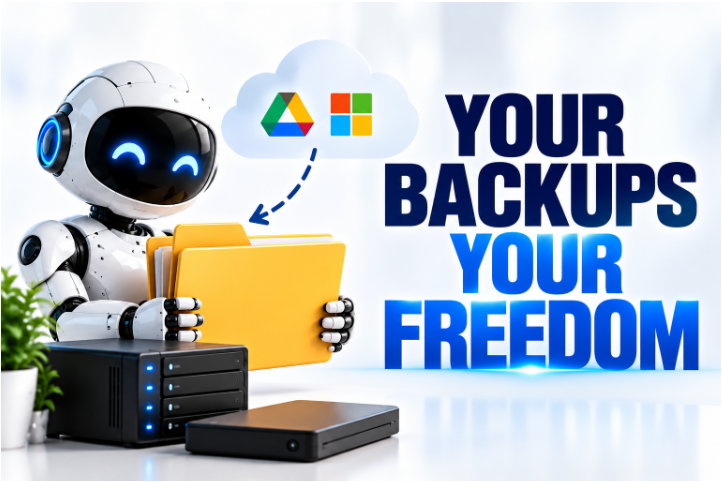
Everything we’ve built — the archive, the knowledge base, the Foundry — lives on machines in your office. One theft, one fire, one failed drive, and it’s gone. Backup isn’t overhead. It’s the business.
Data. Follow the 3-2-1 rule. Three copies of anything that matters. Two different types of storage. One copy offsite. Your working archive on the main machine, a second copy on an external drive, a third copy encrypted and stored elsewhere — another physical location, or an encrypted cloud bucket you control the keys to. Encryption matters: a backup you can’t restore securely is a liability, and a backup someone else can read is a leak.
Test the restore. A backup that has never been restored is a hypothesis. Once a quarter, pull a random folder back from the offsite copy. Ten minutes. That is the whole test. If it fails, fix it now — not during the emergency.
Email. If your address is @gmail.com or @outlook.com, you don’t own it — you’re renting it, and the landlord can change terms or lock you out. A custom domain with your address behind it costs little and means you can move providers in a day if you ever need to. Do it before a problem forces you to learn how.
Services. Every tool in your stack holds state: configurations, databases, exports. Self-hosted tools need their own backups — configs included, not just files. Write down what you run and what needs exporting. That document is also your recovery runbook when something breaks at the worst moment.
Solo consultants have a bus factor of one. Backups, restores, and written procedures are how the business survives a bad week.