Many people use these tools without knowing what happens when they submit a question. Here is what happens, without the mathematics.
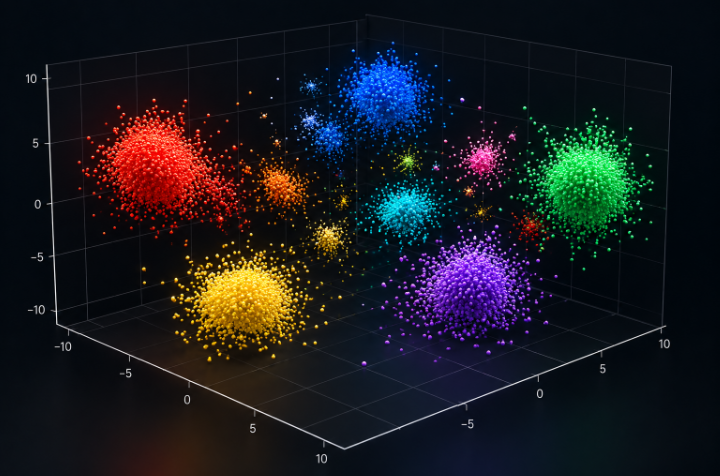
Your words become numbers. When you type “What is CBAM?”, the computer can’t read. It converts your text into tokens — small chunks of words — and each token becomes a list of numbers. Those numbers are not code. They’re more like coordinates: a position in a giant map of meaning where “carbon” sits near “emissions” and “tax” sits near both.
The model is a prediction machine. An AI model is, at heart, one enormous pattern-matching system trained on mountains of text. Trained is the key word — nobody programmed answers into it. It learned, by example, which patterns of words tend to follow which other patterns. Like a person who has read every book in the library and can quote the likely next sentence.
Inference is the ask-and-guess loop. When you send your question, the model takes your numbered tokens and asks itself one question, over and over: what token most plausibly comes next? It picks one, adds it to the pile, and asks again. “CBAM is…” → “the” → “EU’s” → “carbon”… Word by word, the answer assembles itself. Every word you read was a fresh guess, each one shaped by everything before it.
That explains a lot. Why it writes so fluently — it’s literally built to produce plausible sequences. Why it hallucinates — plausibility isn’t truth, and nothing inside checks facts. Why the same question can get different answers — each run rolls dice at every step, weighted toward likely choices.
And why your data matters. The model’s “knowledge” is frozen at training time. It knows nothing about your projects unless your tools search your archive first and hand it the relevant pieces — which we will cover when we look at organising and searching a private archive in articles 16–18.
The distinction matters when checking answers, particularly figures and references.