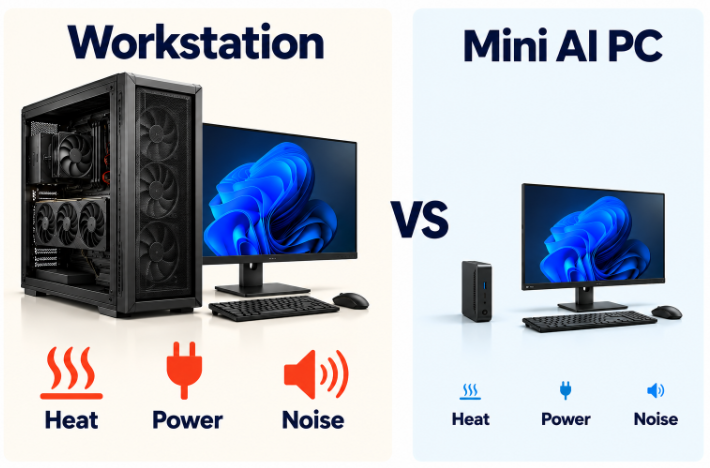
A consultant asks how much electricity a local AI machine uses. Rather than compare it vaguely with a data centre, calculate it.
Suppose a mini PC averages 60 watts for eight hours a day. That is 0.48 kilowatt-hours a day, or about 175 kilowatt-hours over a year. At an illustrative electricity factor of 0.4 kilograms of CO₂ equivalent per kilowatt-hour, the operational emissions would be around 70 kilograms of CO₂ equivalent annually. Those are example assumptions, not measurements of our machine.
The real figure depends on the computer, model, workload, local grid and whether the machine runs overnight. A video-generation job may draw far more power than document classification. Manufacturing the equipment has an environmental cost too.
We prefer local AI processing for many professional tasks because it gives us control over confidential information and makes local electricity consumption measurable. But local is not automatically lower-carbon than cloud. Cloud models, including rented GPUs on Runpod, run in data centres with their own electricity, cooling and water demands. A comparison needs equivalent workloads and credible measurements.
Use a plug-in power meter if appropriate, record idle and working power, and write down the hours. Article 44 looks at the wider environmental costs. That is a more defensible answer than claiming local AI is always the lighter option.