AI uses electricity, water and manufactured hardware. The footprint depends on what the system does, where it runs and how long it runs.
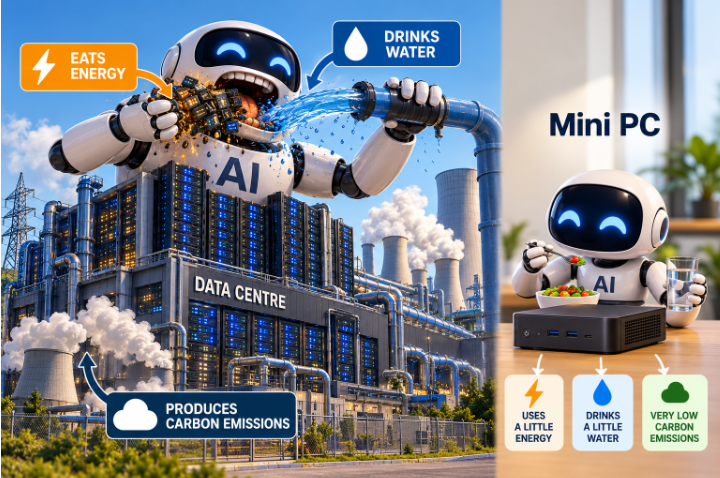
We have a strong preference for local AI processing for professional work, particularly when confidential data is involved. A local computer lets us control where the information is stored and gives us a direct way to measure its electricity use. That does not make its footprint zero: the machine still has an embodied manufacturing cost.
Cloud AI runs in data centres. Those facilities consume electricity and may use water for cooling, with impacts varying by location and design. Rented GPU services such as Runpod also use data-centre infrastructure. They can be useful for occasional heavy tasks, but should not be described as local or impact-free.
Consider two jobs. A small local model classifies a batch of public environmental domains. That may be a reasonable task for a modest PC. Generating a short video could require a larger GPU and hours of processing; renting capacity briefly might avoid buying hardware used only occasionally. Whether it reduces total environmental impact needs actual measurements, not assumptions.
A useful comparison records the task, model, hardware, running time, energy use where measurable and any missing provider data. Video resolution and duration should also be recorded because they materially affect compute demand.
Planetary.Blue can share practical measurement approaches with members. The priority is defensible comparisons, not a universal claim that local or cloud is always greener.